


Louisville Slugger Warriors Featured in Fall 2026 Edition of Move United Publication
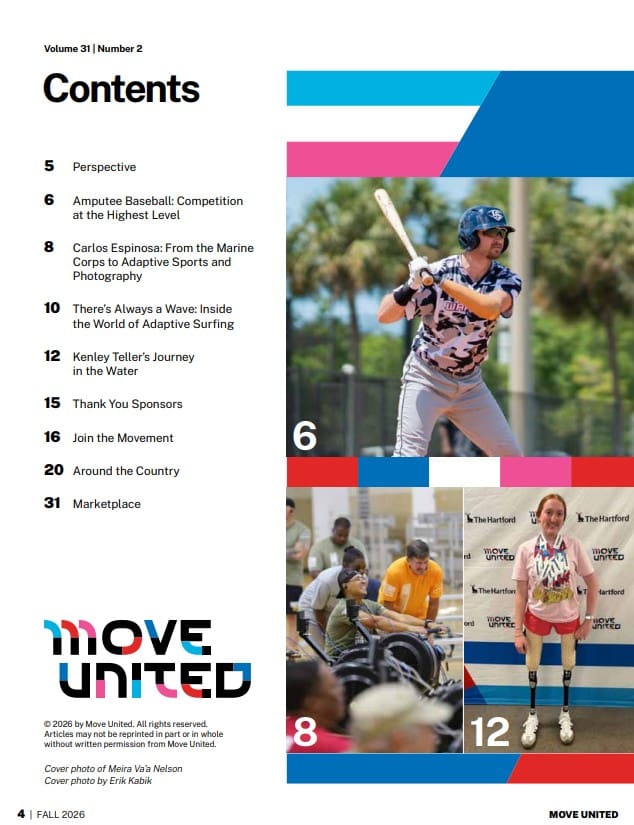 The Louisville Slugger Warriors were featured in the Fall 2026 edition of Move Untied. The Warriors are a veteran competitor in our MSBL National Tournaments. General Manager David Van Sleet kindly sent us a copy of the article. Enjoy!
The Louisville Slugger Warriors are a competitive baseball team made up entirely of amputee athletes, but they play by the same rules, on the same 90-foot base paths, against the same caliber of able-bodied opponents as any other adult baseball club in the country. There is no adapted rulebook for amputee baseball.
The Warriors play standard nine-inning games, often under a three-hour time limit, on full-size fields. “They generally play the same type of rules,” said David Van Sleet, who founded the team in 2018 and continues to run it today. “They’re not modified by any means.”
Because no equivalent amputee league exists to compete against, the Warriors schedule games against able-bodied competition, most often through the Men’s Senior Baseball League, a nationwide organization with 3,500 teams.
Rather than face a single club, the Warriors typically play an all-star team drawn from an entire city’s league, a matchup Van Sleet said better fits the level of competition. “We’ve got to play their all-star team to make it a competitive game.” That level of competition is real.
Van Sleet described facing former college and high school players who are still playing into their thirties and forties, only to run into a Warriors pitcher throwing 92 miles per hour with one arm. “Sometimes it isn’t pretty when a pitcher with one arm is throwing 92 miles an hour,” he said. Every player on the roster is either a below-knee amputee, an arm or hand amputee, or an athlete with a limb difference.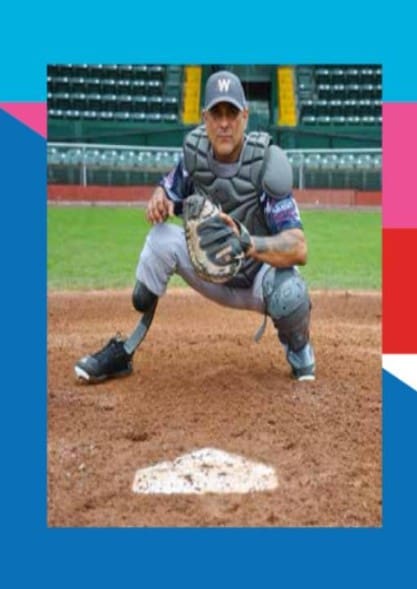
Position assignments generally follow mobility. Leg amputees tend to play infield, where quick range and footwork matter most, while arm and hand amputees often play outfield, where they cover ground well and get the ball back in. “Nine times out of 10 they can get to the ball and make a throw,” Van Sleet said.
Prospective players submit videos of themselves running, hitting, throwing, and making lateral movements, and the team’s two coaches, former MLB outfielder Curtis Pride and a pitching coach who played three years professionally, evaluate the talent. A prior college playing career is expected.
A spot on the team is earned, not guaranteed, even for established players. The roster holds 15 players, enough to field a lineup with reserves, though pitching depth remains a constant challenge. “They’re always telling me we need more pitching, we need more pitching, but we seem to get through an event with what we got,” Van Sleet said.
Most players compete for local men’s league teams in their home cities during the season and join the Warriors for travel games, a system that keeps them sharp between events. Lower-leg amputees keep their prosthetics in full working order for competition and often bring a spare, and the team typically arranges for a local prosthetics company to volunteer basic tools for on-the-road adjustments.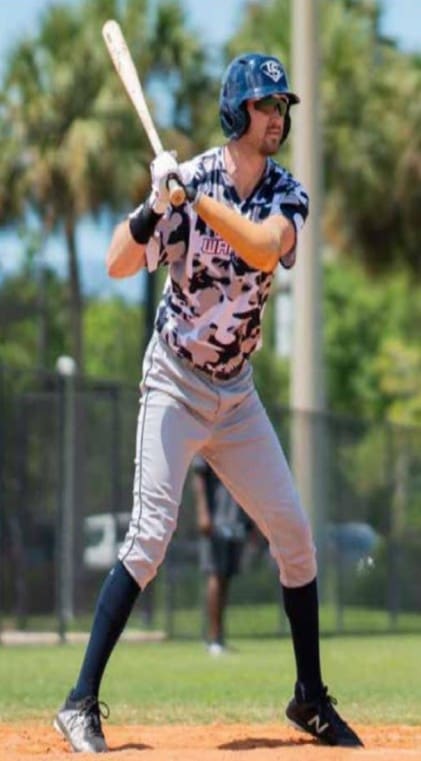
Only one current player wears a prosthetic arm to bat. He hit 30 home runs in high school, played Division II baseball, and went on to pitch in independent professional baseball. Other players bat and field without a prosthesis.
Van Sleet pointed to a 25-year-old player who broke his college’s home run record using one hand and said, “You’d be amazed how quickly players transfer the ball from glove to throwing hand in the field.
The team travels to a variety of tournaments throughout the year, which guarantees a set number of games over a period of time. A recent visit to the National Baseball Hall of Fame brought the team together with eight Hall of Fame coaches and 24 former players for a military baseball game marking a USA 250th birthday celebration. Beyond tournaments, some cities invite the team directly for special matchups against local men’s teams when funding allows.
Traveling as a 15-person roster across the country is not simple. Van Sleet relies on interns from a nearby university to help coordinate flights, ground transportation, and hotels, aiming to get everyone into the same city around the same arrival time. It costs roughly $15,000 to send the team to a competition, covering airfare, ground transportation, hotel,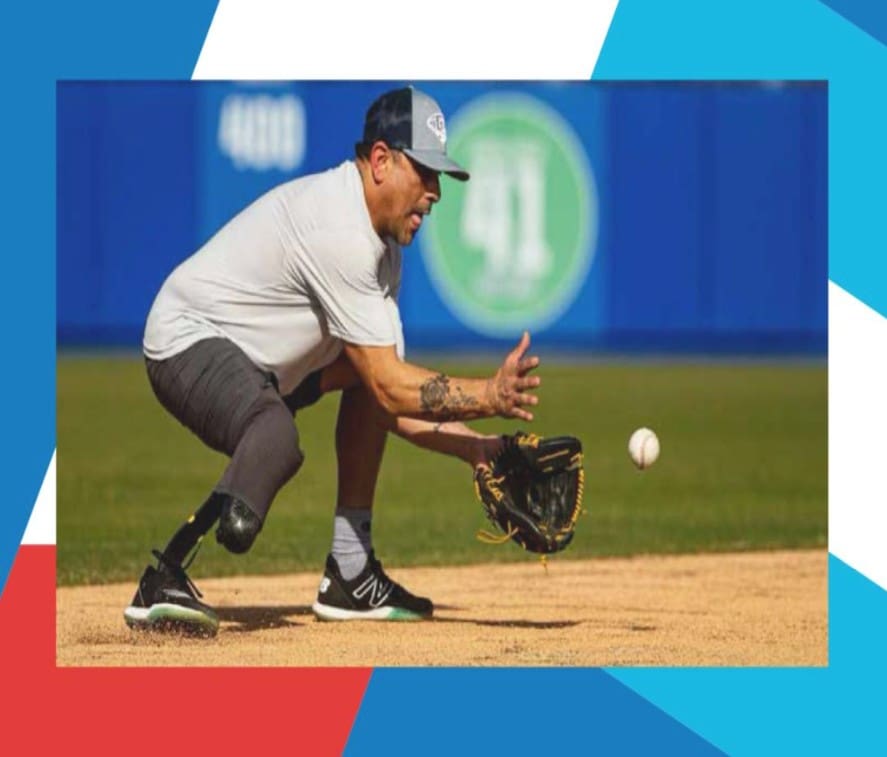 and meals. Van Sleet sees the Warriors as part of a broader shift in what athletes with limb loss and limb difference are able to do. “It’s amazing what some athletes can do and now there’s almost teams or sports for everyone to compete in, so you don’t have to lose a limb or have a limb difference and stay home and watch TV,” he said.
He credited advances in prosthetic technology, driven in part by government investment during recent conflicts, with helping athletes compete at a higher level than in the past.
“The materials have gone to the best standards now, and they’re very strong, and they last,” he said. For more information on the Louisville Slugger Warriors, visit LSWarriorsTeam.org.