


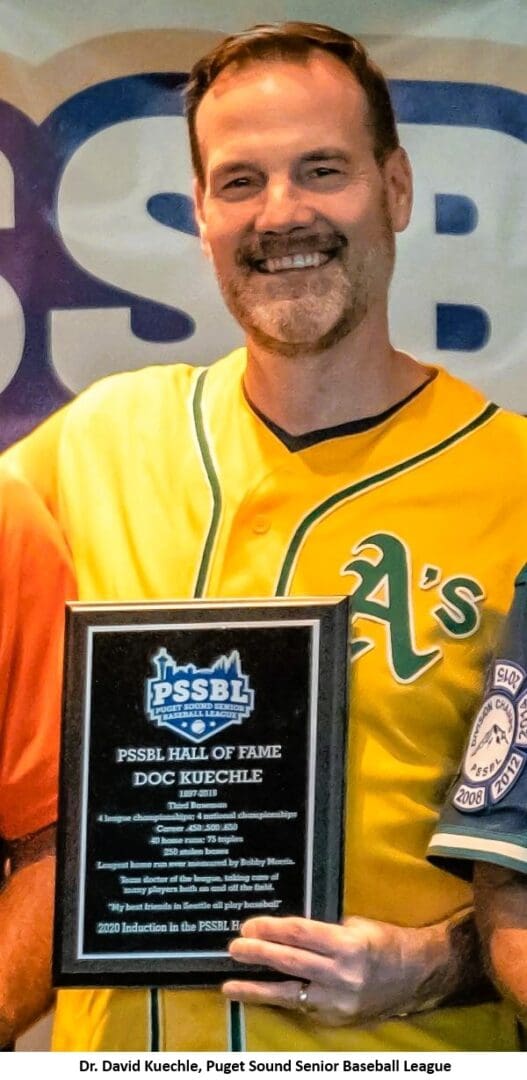
Concentrating on Health and Longevity, Dr. David Kuechle, M.D., Puget Sound Senior Baseball League
In this post, I’m going to focus on health and longevity. To me, this is not just living longer, but more being healthy for longer. This has been described as lifespan versus health span. There has been a growing number of experts in this field that have been producing content for the past few years. Although the timing is a bit unfortunate, one of the higher profile names is Peter Attia, M.D. who wrote a book called Outlive and also has a podcast called The Drive. Regardless of what you feel about the individual, the information is useful and I will borrow some of his concepts for this post. There are many informative podcasts in this field, including The Huberman Lab by Andrew Huberman, Ph.D., and FoundMyFitness by Rhonda Patrick, Ph.D. among others. Finally, the book Why We Sleep by Matthew Walker, Ph.D. has a ton of interesting information about the critical role sleep provides to our health, underpinning much of the other elements of health.
 All of us know people who are gone too soon – friends, family, people we’ve played ball with and against. Some of us have had brushes with our own mortality, whether it be cardiac events, cancer or illness. Yet it seems like many of us keep making the same mistakes, even after the warning we received. As a doctor, I can tell you I spent a lot more time in my training learning how to intervene when something catastrophic happened, rather than how to prevent the catastrophe in the first place. Our current medical system excels in reacting to problems, but falls down in the prevention arena. Much of longevity medicine is about prevention – identifying the primary risks we face, evaluating the data, and making recommendations about ways to head off disaster before it’s too late.
In Outlive, Attia identifies what he terms “the four horsemen” which are conditions that lead to the majority of illness, disability and death in our country: cancer, cardiovascular disease (i.e. MI, stroke), metabolic disease (i.e. diabetes, high cholesterol, obesity) and neurodegenerative disease (i.e. dementia.) Later in the book he also mentions mental health/relationships as being another key to health and wellness. As you can imagine, many of the four horsemen diseases are interconnected. Poor metabolic health (elevated blood glucose/diabetes, obesity) leads to cardiovascular disease due to the deposition of plaque in blood vessels which leads to compromised immune function due to inflammation and stress, resulting in more cancers and also neurodegenerative disease because the brain doesn’t have adequate blood flow/nutrition. Making inroads in preventing or addressing any of the above horsemen diseases has wide ranging benefits in preventing the others.
Going into great detail about prevention strategies is beyond the scope of this post. However, I will list a few strategies that I think are key. Perhaps the single most important prevention strategy is an ongoing, consistent exercise program, including both resistance and endurance training, as well as balance exercise. This should be the foundation of everything else. A normocaloric diet is also critically important – if I was being charitable, I would say that many of us are “over-nourished.” There’s a reason the standard American diet has the acronym “SAD.” There has been more emphasis on protein intake (1.6g/kg do ideal body weight) to prevent muscle loss associated with aging (called sarcopenia.) Obviously, avoiding smoking and using moderation in use of alcohol are self-evident. Getting adequate sleep (>7 hours per night for most of us) should also a foundational goal. There are certain supplements that may be useful – such as a B complex vitamin and vitamin D. Fish oil is also helpful in preventing cardiovascular disease and dementia. Recent data out of Europe suggests that 20 minutes in a 180 degree sauna 4 times a week may lower the risk of dementia and sudden cardiac death by 60%.
I should also mention some tests that are incredibly useful as screening tools and to help inform your health strategies. On the prevention side, regular colonoscopies and prostate evaluation should be mandatory. There is some nuance here, especially regarding how to interpret the prostate evaluation, but your PCP should be able to help you navigate this. There is something called a “liquid biopsy” which is a blood test looking for DNA markers of cancers as an early warning system. A calcium study is CT scan looking at the amount of plaque build up in your cardiac arteries by quantifying the amount of calcium present. There are whole body MRI scans that screen for a whole host of issues. A more comprehensive lipid panel than the standard LDL, HDL test most of us get, looking at lipid subparticles, can help your PCP to know whether your current cholesterol strategy is good enough. There is basically a linear correlation between your LDL and your risk of cardiac mortality – the lower your LDL, the lower your cardiac risk.
On the practical side, a body composition DEXA scan is an eye-opening way to gage your overall body composition (hello, 40 lbs of fat) and bone density. This can provide motivation for the dietary arm of your health strategy. A V02 max study can give you a snapshot of your cardiopulmonary fitness and also provide you with a target heart rate for the various zones of exercise, which can help to inform your workouts. There are a number of places around Seattle that do one or both of these tests.
In summary, the purpose of longevity medicine is to maximize your healthy, active years through preventative measures started while you still have some runway to avoid catastrophe. There are tests that can give you an objective measure of your current fitness to help you create an optimized health strategy. There are also screening studies to identify problems early, while effective treatments still exist. Your PCP may be able to do this for you, but there are also a growing number of providers in the longevity medicine space. There is an abundance of useful information out there in the form of books and podcasts, such as those I’ve alluded to previously. I encourage you to make use of all of it so that you can stay out there longer, swinging the bat, running the bases, beaning members of the opposing team (looks at Carl), and making fun of your teammates and buddies in the other dugout. Isn’t that what life’s all about?